
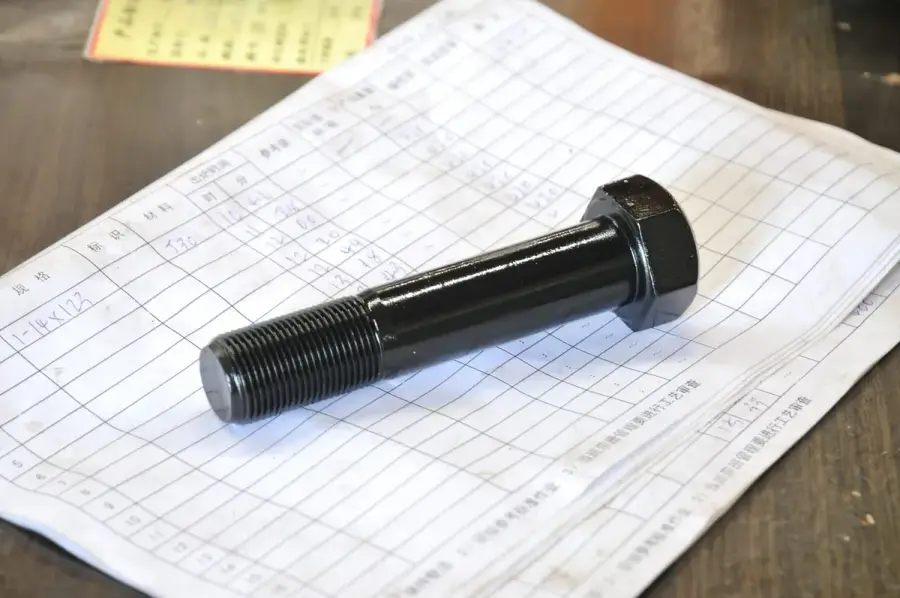
Wheel end failures are among the most costly and dangerous issues in commercial vehicle maintenance. A failed hub bolt can lead to wheel separation, vehicle instability, and catastrophic accidents. Understanding why hub bolts fail —and how to prevent it —is essential for fleet operators, maintenance technicians, and parts procurement teams.
Common Hub Bolt Failure Modes
1. Fatigue Failure
Fatigue is the leading cause of hub bolt failure, accounting for an estimated 60-70% of all failures. It occurs when bolts are subjected to repeated cyclic loading over time. Key characteristics:
- Beach marks on the fracture surface —concentric rings indicating progressive crack growth
- Final fracture zone —the rough, crystalline area where the bolt finally snapped
- Root cause —insufficient clamping force, usually due to improper torque or bolt stretch loss
Fatigue failures develop slowly. A bolt may have been cracking for thousands of miles before final separation. Regular inspection can catch early-stage fatigue before it becomes critical.
2. Overload Failure
Overload failures occur when the applied force exceeds the bolt's tensile strength in a single event. Causes include:
- Impact loads from potholes, curbs, or road debris
- Excessive torque during installation (stretching bolt beyond yield point)
- Using a bolt with insufficient strength grade for the application
Overload fractures show a cup-and-cone pattern with necking (reduction in cross-section) near the break —distinct from the flat, smooth fatigue fracture.
3. Corrosion-Induced Failure
Corrosion weakens bolts through material loss and creates stress concentration points. Particularly problematic in:
- Coastal and marine environments (salt spray exposure)
- Regions using road salt during winter
- Chemical and industrial processing areas
Corrosion pitting reduces the effective cross-section of the bolt and initiates fatigue cracks. Even bolts that appear visually intact may have significant hidden corrosion between the hub and wheel interface.
4. Thread Stripping and Galling
Thread damage can prevent proper torque application and reduce clamping force:
- Galling —cold welding between mating threads, common with stainless steel fasteners
- Stripping —deformation or shearing of thread flanks from over-torquing or cross-threading
- Fretting —micro-movement between threads causing wear and material loss over time
Inspection and Early Warning Signs
Implement a regular inspection program to catch issues before they lead to failure:
| Sign | What to Look For | Action |
|---|---|---|
| Rust streaks | Orange/brown lines radiating from bolt head | Replace bolt immediately —crack likely present |
| Loose wheel nuts | Nuts that can be turned by hand or torque wrench reads below spec | Re-torque to spec; investigate underlying cause |
| Visible cracks | Cracks at bolt head-to-shank transition | Replace all bolts on that wheel position |
| Corrosion scale | Heavy rust buildup on bolt surfaces | Clean and evaluate; replace if section loss is visible |
| Wheel wobble | Play detected during wheel bearing check | Inspect all hub bolts and bearings immediately |
Best Practices for Hub Bolt Selection
Choose the Right Strength Grade
- Class 10.9 —standard for most commercial vehicle hub bolts
- Class 12.9 —heavy-duty applications, mining and construction equipment
- Never substitute a lower grade bolt, even if it appears to fit
Select Appropriate Surface Coating
- Zinc plating —adequate for normal highway use
- Dacromet/Geomet —recommended for coastal, winter salt, or industrial environments
- Zinc-Nickel —premium option for extreme corrosion environments
Verify OEM Cross-Reference Numbers
Always cross-reference with OEM part numbers to ensure dimensional and material compatibility. Common cross-references for Carelong hub bolts include:
- CAT —various hub bolt numbers for mining and construction equipment
- Komatsu —OEM numbers for heavy equipment wheel assemblies
- BPW —European trailer axle hub bolt specifications
Installation Best Practices
- Clean all mating surfaces —remove dirt, rust, and old lubricant from hub face, wheel pilot, and bolt holes
- Use a calibrated torque wrench —never use impact guns for final tightening
- Follow the correct torque sequence —star pattern, not circular
- Torque to specification —refer to vehicle manufacturer's manual, not generic charts
- Re-torque after 50-100 miles —critical step often skipped; bolts settle and lose initial clamping force
- Replace bolts, don't reuse —hub bolts are designed for single-use; the torque-to-yield design means they've already been stretched
At Carelong, we manufacture hub bolts to exact OEM specifications with full material traceability. Our bolts are produced under ISO 9001; Our manufacturing facility is IATF 16949 certified, with 100% in-line inspection. Contact us for cross-reference numbers and competitive pricing.
Need Reliable Hub Bolts?
View our hub bolt product range or contact our team for a quotation within 24 hours. We serve fleet operators, parts distributors, and OEMs in over 32 countries.